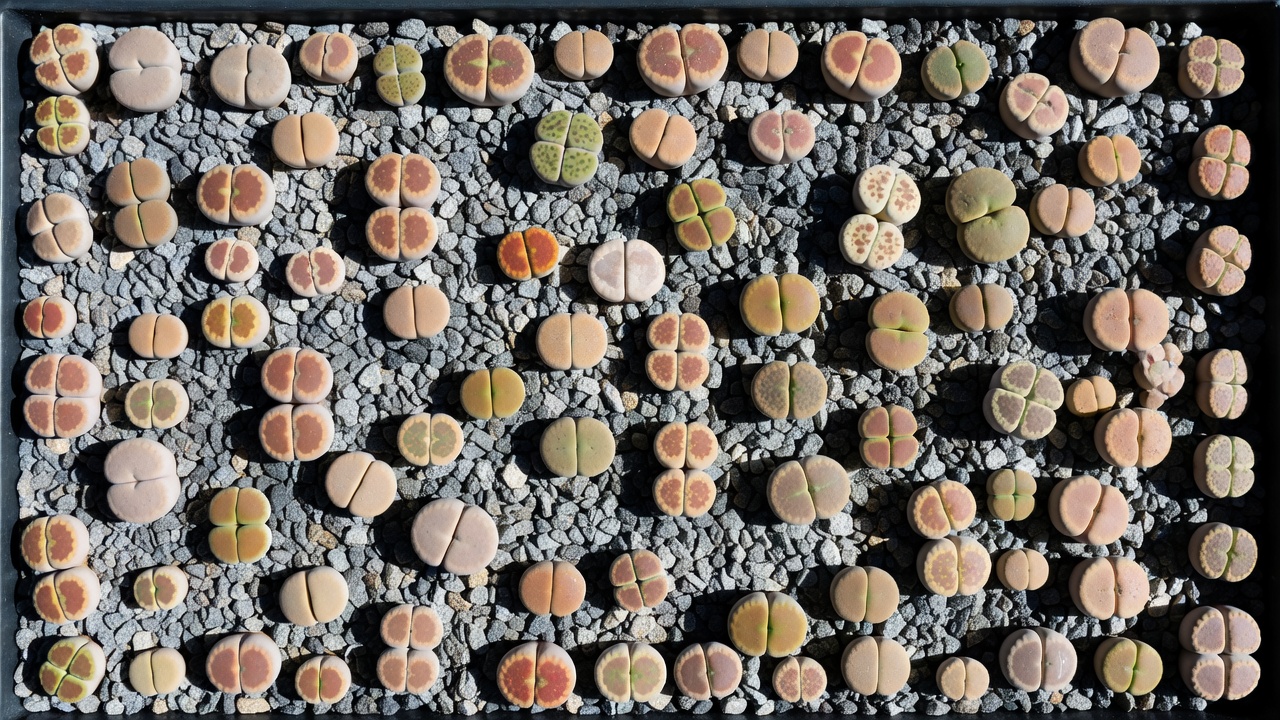
Echeverias and jade plants are pleasant enough, but the succulent world holds far stranger forms. Many of the most remarkable come from the winter-rainfall deserts of southern Africa, where plants have evolved to hide from grazing animals, store water for months and photosynthesise through tiny translucent "windows". Grow them well and they are long-lived companions; grow them like ordinary houseplants and they turn to mush.
Living stones and windowed leaves
Lithops, the living stones of Namibia and South Africa, consist of just one pair of fused leaves that mimic the colour and texture of surrounding pebbles. Each year a new pair forms inside the old one, absorbing its water and nutrients. The golden rule: do not water while the old leaves are shrivelling, usually through winter and spring. Water mainly in late summer and autumn, when the plants grow and push out yellow or white daisy-like flowers from the central fissure.
Haworthia cooperi and baby toes (Fenestraria rhopalophylla) take the window idea further. Their leaf tips are translucent, letting light into the leaf interior while most of the plant stays buried in sand. Grown in bright, indirect light, they glow like small lanterns — one of the most striking effects in any windowsill collection.
Sculptural oddities
Euphorbia obesa, the baseball plant, is a near-perfect striped sphere from the Karoo in South Africa. It is endangered in the wild, and responsible sellers now offer only seed-raised plants. Male and female flowers are borne on separate plants, so you need both to produce seed.
Agave victoriae-reginae, the Queen Victoria agave, forms a tight dome of dark green leaves edged with crisp white lines. It is slow, compact and ideal for a large pot. String of pearls (Curio rowleyanus) trails bead-like leaves over the edge of a hanging pot; let it dry between waterings and avoid deep pots that stay wet.
Aeonium arboreum 'Zwartkop', from the Canary Islands lineage, produces glossy, near-black rosettes on branching stems. Unlike most succulents it grows in the cool months and goes semi-dormant in summer heat, when it curls its rosettes tight. Shade it slightly in a heatwave and water less.
Soil, water and light
- Soil: at least half mineral — pumice, horticultural grit or perlite — mixed with a little peat-free compost.
- Pots: terracotta with a drainage hole. Unglazed clay breathes and dries quickly.
- Water: soak thoroughly, then wait until the mix is completely dry. Most succulent deaths are caused by overwatering, not drought.
- Light: as bright as possible, but acclimatise plants gradually when moving them outdoors to avoid sun-scorch.
- Winter: cool and dry suits most summer growers. Stretched, pale growth (etiolation) means not enough light.
Hardy succulents for outdoor gardens
In cold climates you can still grow succulents outside. Houseleeks (Sempervivum), ice plant (Delosperma cooperi), Orostachys and many stonecrops (Sedum) cope with hard frost provided winter wet drains away instantly. Crevice gardens — slabs of stone set on edge with gritty soil between — are the perfect home and a striking design feature in their own right.
Gardens that will change how you see succulents
The Desert Garden at The Huntington in San Marino, California, developed from 1907 under the guidance of William Hertrich, remains one of the great collections. Lotusland in Montecito, created by the opera singer Ganna Walska, shows succulents used theatrically, while Jardin Majorelle in Marrakech pairs cacti with electric colour. Closer to home, the Princess of Wales Conservatory at Kew displays arid plants in carefully controlled climate zones.
A note on poaching
High demand has driven illegal collection of wild succulents, including Californian Dudleya and many South African dwarf species. Buy seed-raised or cutting-grown plants from named nurseries, and treat suspiciously old, scarred or "field-collected" specimens as a warning sign.
| Plant | Growth season | Water when | Watch for |
|---|---|---|---|
| Lithops | Late summer–autumn | Actively growing only | Splitting from overwatering |
| Euphorbia obesa | Spring–summer | Soil fully dry | Corking at base from cold, wet soil |
| Aeonium 'Zwartkop' | Autumn–spring | Cool months | Summer heat stress |
| Curio rowleyanus | Spring–autumn | Beads slightly wrinkled | Rot in deep pots |