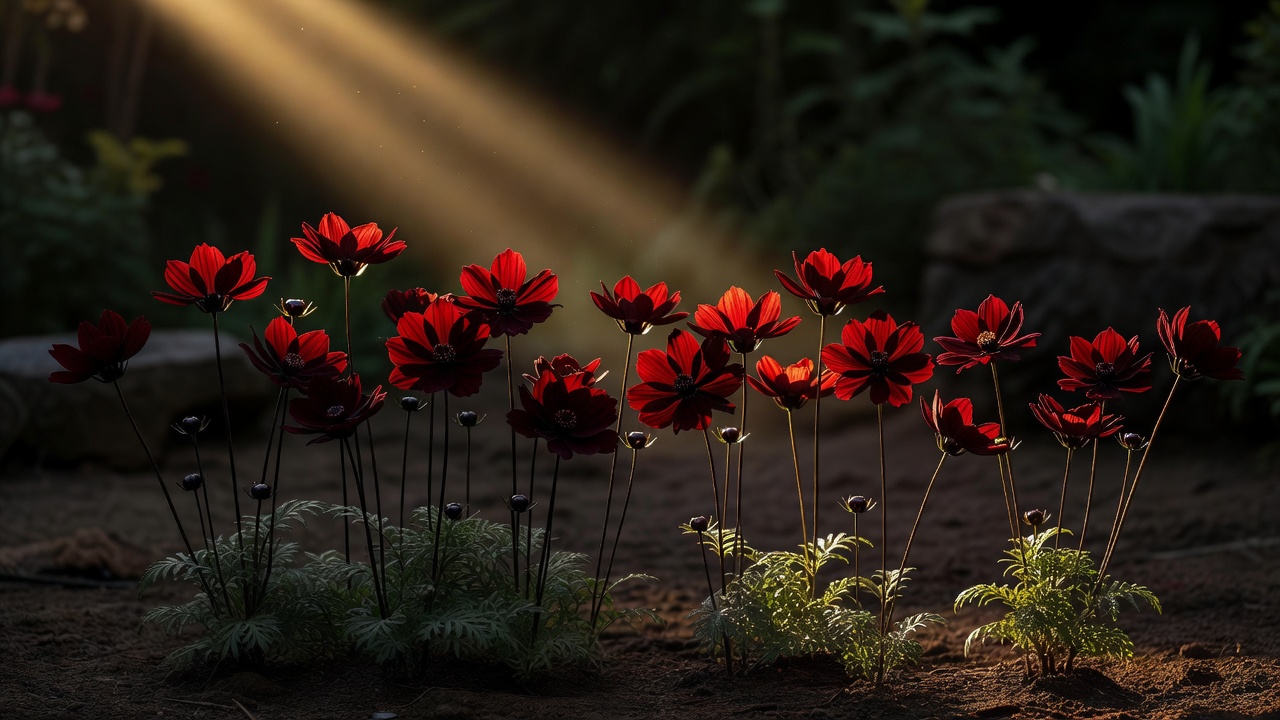
Rarity in the garden is a slippery word. Some plants are rare because they are threatened in the wild; others are rare in garden centres simply because they are slow to propagate, awkward to ship or too odd for mass-market taste. This guide is about the second kind: flowers you can legitimately buy and grow, but which still make visitors stop and ask what on earth they are looking at.
Dark, strange and sculptural blooms
Chocolate cosmos (Cosmos atrosanguineus) is the classic entry point. Native to Mexico and long regarded as extinct in the wild, it survived in cultivation for decades largely as a single clone that would not set seed. Its velvety maroon flowers smell faintly of cocoa on warm afternoons. Treat the tubers like dahlias: mulch deeply in mild gardens, or lift and store them frost-free where winters are hard.
Black bat flower (Tacca chantrieri) comes from the humid forest floors of Southeast Asia. Its purple-black bracts spread like wings, trailing whisker-like filaments that can hang well below the bloom. It is not hardy and wants warmth, high humidity and shade — a heated conservatory or a bright bathroom suits it far better than a border.
Cobra lilies (Arisaema) are the woodland garden's showpieces. Arisaema sikokianum, from Japan, produces a dark striped hood wrapped around a gleaming white, club-shaped spadix. Tubers emerge late in spring, so mark their position to avoid spearing them with a fork. Give them leafy, moisture-retentive soil and dappled shade.
For height, Fritillaria persica sends up spires of dusky plum bells, while its cousin the crown imperial (Fritillaria imperialis) adds hanging orange or yellow bells and a famously foxy smell. Both need sharp drainage; plant the bulbs on a little grit and slightly on their side to stop water collecting in the hollow crown.
Fragrance that changes the garden after dark
Scent is the most underused design tool in most gardens. The regal lily, Lilium regale, has a dramatic history: the plant hunter Ernest Henry Wilson found it in the Min River valley of western Sichuan in 1903, and on a later expedition in 1910 his leg was badly broken in a landslide while he was collecting its bulbs. Today it is one of the easiest lilies to grow in pots, perfuming a whole terrace in midsummer. Watch for scarlet lily beetle and pick it off early.
In late winter, Daphne odora 'Aureomarginata' fills cold air with a sweet, citrusy perfume. It resents root disturbance, so plant it once and leave it alone. Christmas box (Sarcococca confusa) does a similar job in shade; place it beside a door or path where you will brush past it.
For evenings, grow Nicotiana sylvestris, whose long white trumpets release scent at dusk to attract moths, alongside sweet rocket (Hesperis matronalis) and night-scented stock (Matthiola longipetala). Sow stock thinly near seating: the flowers are plain, the fragrance is not.
Sourcing rare plants responsibly
Many unusual plant groups — including orchids, cyclamen, snowdrops and most cacti — are covered by CITES, the Convention on International Trade in Endangered Species. That does not make buying them wrong, but it does make provenance important. Always ask whether stock is nursery-propagated, and be wary of extremely cheap "rarities", especially bulbs and tubers sold in bulk. Specialist nurseries, plant fairs and society seed exchanges, such as those run by the Alpine Garden Society and the Hardy Plant Society, are the safest routes. The RHS Plant Finder is useful for locating which nurseries actually list a given variety.
Growing notes at a glance
| Plant | Flowers | Position | Winter care |
|---|---|---|---|
| Cosmos atrosanguineus | Midsummer–autumn | Sun, free-draining | Mulch or lift tubers |
| Tacca chantrieri | Summer | Warm shade, humid | Indoors, above about 15°C |
| Arisaema sikokianum | Late spring | Dappled shade | Hardy; mulch in cold areas |
| Lilium regale | Midsummer | Sun, pots or borders | Hardy; avoid waterlogging |
| Daphne odora | Late winter | Sheltered, part shade | Hardy in most areas |
Making rare flowers look intentional
A single odd plant can look like an accident. Repeat it, or give it a stage: a dark-flowered cosmos glows against silver foliage such as Artemisia, and black or plum blooms read far better against lime-green leaves than against dark soil. Raise woodland treasures like Arisaema in a shallow raised bed so their hoods sit closer to eye level. Rarity draws the eye; good staging keeps it there.