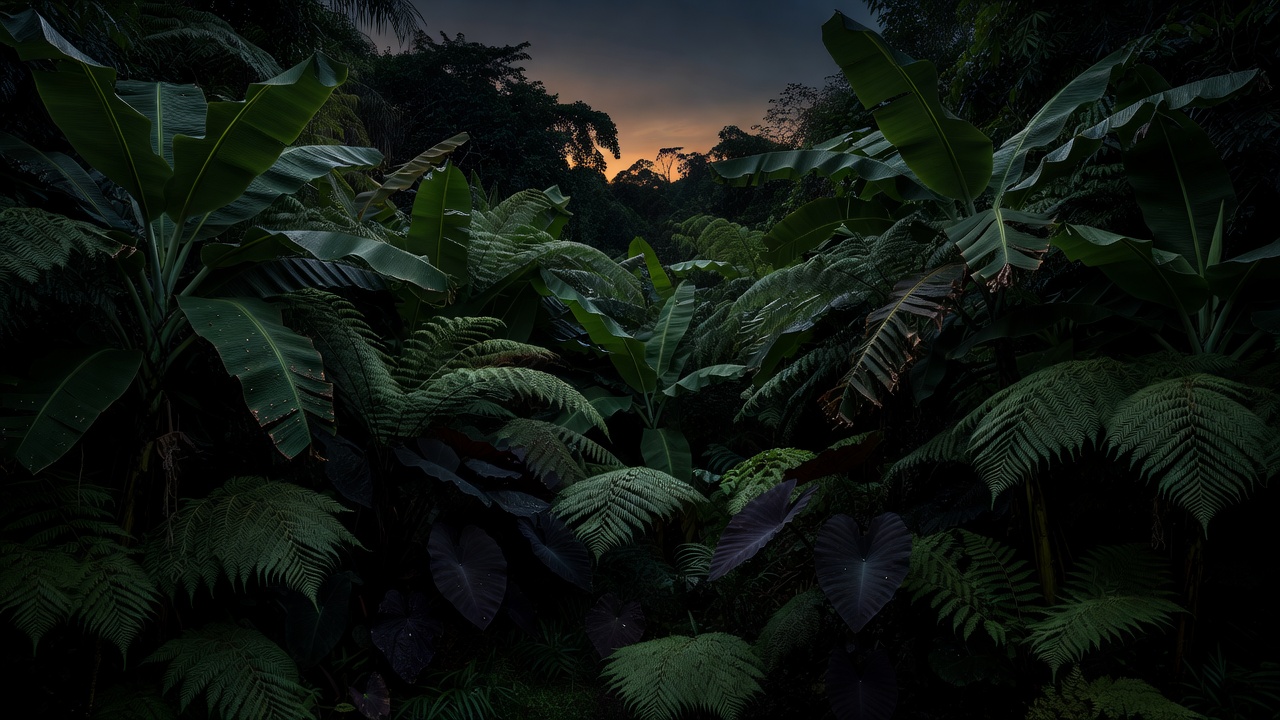
Flowers come and go, but leaves carry a garden from late spring to the first frosts. Exotic-looking foliage — huge paddles, deeply cut fronds, near-black or silvered surfaces — gives instant drama and works especially well in small, sheltered urban gardens, which are often several degrees warmer than open countryside. The trick is combining genuinely hardy plants with a few tender ones you are prepared to protect.
Big leaves with hardy roots
Rice-paper plant (Tetrapanax papyrifer 'Rex') produces lobed leaves that can approach a metre across on vigorous young shoots. It suckers freely, so give it room or a root barrier. Top growth may be cut back in a hard winter, but established roots typically survive frosts of around −10°C and resprout.
Japanese fibre banana (Musa basjoo) is the hardiest commonly grown banana. Its rhizome survives cold winters under a deep mulch; to keep the tall pseudostem and get a head start, wrap it in fleece and straw or a ventilated cage. The leaves shred in wind, so a sheltered spot pays off.
Fatsia japonica is the dependable evergreen backbone: glossy, hand-shaped leaves that thrive in shade where other exotics struggle. For waterside drama, Gunnera manicata from southern Brazil produces leaves big enough to stand under; fold its own dead leaves over the crown each autumn as winter protection. Ornamental rhubarb (Rheum palmatum) gives a similar effect on a smaller scale.
Dark, silver and coloured leaves
Colocasia esculenta 'Black Magic' has matt, purple-black leaves that look carved from velvet. It loves heat, rich soil and plenty of water — some growers stand pots in shallow saucers in summer. Lift and store tubers frost-free over winter.
The red Abyssinian banana (Ensete ventricosum 'Maurelii') carries wine-red leaves on a thick trunk. It is not hardy and needs a frost-free, bright place over winter, but one summer specimen transforms a terrace.
Honey bush (Melianthus major) from South Africa has serrated, blue-grey leaves that smell oddly of peanut butter when crushed. Planted against a warm wall, its roots usually survive moderate frosts. Cannas with striped leaves add colour and are easy to lift and store.
Ferns and palms for structure
Soft tree fern (Dicksonia antarctica) is unusual in that much of its rooting happens through the fibrous trunk itself. Water the trunk and crown, not just the soil, during dry spells, and stuff the crown with straw or fleece in winter. Chusan palm (Trachycarpus fortunei) is one of the hardiest palms, tolerating cold well below freezing once established, and gives evergreen height year-round.
Gardens that show how it is done
In 1993 Christopher Lloyd and head gardener Fergus Garrett replaced the old rose garden at Great Dixter in East Sussex with a bold Exotic Garden of bananas, cannas and dahlias — a move that shocked traditionalists and influenced a generation of designers. Abbotsbury Subtropical Gardens in Dorset shelters huge-leaved plants in a frost-pocket-free valley near the sea, while Tresco Abbey Garden in the Isles of Scilly, begun by Augustus Smith in the 1830s, grows plants that would fail almost anywhere else in Britain.
Designing with foliage
Contrast is everything. Set paddle-shaped banana leaves against fine bamboo or grasses; place black colocasia in front of lime-green or variegated plants; use the vertical spears of cannas to break up mounded shapes. Plant densely: an exotic border should feel enclosing, with leaves overlapping at head height and paths that disappear around corners.
Overwintering plan
| Plant | Rough tolerance | Winter method |
|---|---|---|
| Musa basjoo | Rhizome to about −10°C mulched | Deep mulch; wrap stem for height |
| Tetrapanax 'Rex' | Roots to about −10°C | Mulch; cut back damaged stems in spring |
| Dicksonia antarctica | Brief frosts with crown protected | Straw in crown; wrap trunk in severe cold |
| Colocasia 'Black Magic' | Not frost-hardy | Lift tubers; store dry and frost-free |
| Ensete 'Maurelii' | Not frost-hardy | Bright, frost-free room or greenhouse |
Figures are approximate and depend heavily on drainage, wind exposure and the length of the cold spell. Wet cold kills far more exotics than dry cold.